Cautionary Note: I wrote this before I had done thorough research. I may have misdiagnosed my ex-boyfriend. He may not have been a psychopath.
My ex-boyfriend Brendan took his life 13 years ago and, in some ways, I've been living with his ghost all these years. Deep inside I think I knew that he was a psychopath, but I never stuck the label on him until a few days ago when I read a list of traits of a psychopath. It's been a shock to me to finally wake up out of my denial. The problem with the list is that it is only part of the picture, albeit the most damning part. From what little I've read on the internet, those who have studied psychopaths say that they are hopeless, without any redeeming characteristics, worthy only of being shunned by society or being put in prison or even killed. While I certainly understand the reasons behind this condemnation, having lived with a psychopath for over 5 years, I know in my heart that it is an unjust attitude and position.
Certain studies have shown that there are brain abnormalities in psychopaths. This makes them lack empathy, which in turn makes them not pick up on signs of fear and distress in others. I witnessed this type of apparent callousness in Brendan at the climaxes of his abusive cycles. At those points no amount of begging or sobbing could reach him. In my eyes at the time this made him a temporary monster. I know I called him evil to his face at least once and in my mind I compared him to the stereotype of a Nazi. It's natural for some people to learn to become callous towards others in reaction to having been abused, but what if physically, in your brain structure, you had a predisposition to it even before ever being abused? And then what if you had been abused in one way or another, as Brendan said he was by his father, and went on in reaction to this to cultivate that budding abusive personality? By the time I met Brendan at the tender age of 18 he had made his abusiveness part of his identity, though I didn't know it at the time. I didn't know that he had a reputation for being a skillful fighter and that some of his friends even admired him for it. One of his best friends once called him "a lean, mean fighting machine."
So Brendan was born with a disability that got exacerbated by environmental conditions, primarily by having been abused by his father. This disability led him to show signs of behavioral problems when he was only 4 or 5 years old when he got kicked out of either nursery school or kindergarten for being repeatedly aggressive towards some of the other students. When a little child can't read the faces and body language of other little children, he (or she) can't follow the cues to modify his (or her) behavior. Children naturally have a lot of energy and curiosity and all that enthusiasm can easily get out of control. Hence the need for good role models, usually parents and teachers, who firmly guide the children towards basic forms of self-discipline. Children are naturally self-centered, but when you take away the ability to empathize with others, an ability that normal children have, you are left with a pathological egocentricity much of the time. Unfortunately, egotism is arrogance and arrogance leads to testing limits and testing limits with others often involves crossing the line into aggressiveness.
Children learn by mimicking language and behavior, but if you take your heart out of it, it becomes a lesson in learning to manipulate people and situations in order to get what you want. Brendan was taught to be manipulative by his family, friends and teachers. Initially, I really don't think he knew any better. He knew he had to survive and in order to do that he mostly followed the group. The group taught him the value of being charming and it helped that he was attractive, physically agile and good at athletics. Not only are human beings intelligent and therefore manipulative, we focus on a reward system for learning new behaviors. Overtime Brendan learned that if he was courteous, attentive, perceptive to the cues that he initially kept failing to see in childhood, people would be nice to him, give him things, do things for him. And in his case, they did. This was due in part to his living in a wealthy suburb with other kids who had stuff to offer. He learned to get drugs, sex, people to do his school work, places of refuge from home. He played the role of a popular, though sometimes out of control, jock, the star soccer player on his high school team.
But despite his popularity in some circles, he invariably crossed the line into anti-social behavior. Part of that behavior had to do with the ease with which he could lie, especially to authority figures like his parents and teachers and cops. He started drinking alcohol when he was 12 and by the end of high school he was an alcoholic. He experimented with all sorts of drugs and because these drugs are all still illegal, he began to identify with the subculture of dealers, especially inner city dealers who were often African Americans living in poor neighborhoods. Like a typical wealthy suburban kid, he was drawn to the city and looking for drugs gave him a reason to go there. Not all drug dealers are stereotypical, but I'm sure Brendan came across quite a few who were. In order to be a successful criminal you have to have to be good at lying and manipulation of people and situations. Charm can help, but knowing how to defend yourself is a necessity. Criminals have to be tough or non empathetic towards the people that they are trying to con. Maybe he thought it was a challenge to deal with these dealers. Maybe he recognized them as being similar to himself in some ways. But ultimately, he couldn't deny where he had come from, a place that valued status and there was little status in becoming a criminal and, for the most part, he didn't become one, except later on in the way he treated me.
Brendan didn't get the guidance he needed from a role model he respected at an early age. From what I can gather his father started being tough on him early on, probably when he began showing behavioral problems. Unfortunately tough love on a psychopathic child does nothing to teach him about empathy. Instead it teaches the child about resentment, hostility, aggression. It teaches him the need to be manipulative and to lie, especially to authority figures who misuse their power. It also teaches the child exactly how to be abusive to others. I really believe that when Brendan abused me, he was imitating some of his father's attitudes and behaviors towards him when he was young. Unknowingly I think he used me as a scapegoat. I became a symbol for his father, whom he very much wanted to punish, despite his ambivalence, and a symbol of himself as a child. In a weird way Brendan sometimes abused me to toughen me up to the realities of the world, the way his father had done to him.
The last thing Brendan needed was to be taught more about the value of aggression. He knew quite well about it from an early age. His father paid for him to be trained as a boxer in a misguided attempt to direct his son's aggressive urges into something somewhat socially acceptable. Though Brendan could be a skilled street fighter, he didn't make it in the ring where he had to follow certain rules. But some of his friends still admired his ability to fight and this gave him a wider reputation. All of this was poisonous to his spirit, but fairly natural because of the abnormalities of his brain. It's not just that he slid into what was natural for someone with psychopathic tendencies, but he was actually encouraged to do so. Some people seem to say, don't be violent except under certain circumstances like for police officers or soldiers or defending yourself, your loved ones and your property or putting violent criminals to death. And in some television and movies, the heroes have to be tough, that's part of what makes them "cool". Fantasy films abound in violent behaviors and conflicts. Many video games, the same thing. Sort of an eat or be eaten mentality. To someone with an emotional deficit of empathy this is extremely counterproductive. It's a mixed message coming from all over the place and fosters ambivalence.
The truth was that though Brendan could fight well, he confessed to me that he really didn't like it. And interestingly enough, when he moved in with me the incidents of him getting into fights was nearly nonexistent. I never even saw Brendan fight someone else. He would terrify and humiliate me and do other things, but he didn't punch me, except for once when he gave me a black eye. I think he knew very well that he could really damage me that way, so he reigned it in even when he got into a hateful mood. One thing he didn't reign in was his verbal abuse, that would go on for hours along with physical threats and acts of humiliation. During those times he was often drunk and definitely psychotic. His psychosis was temporary, but focused on jealousy. This was not normal jealousy; this was malignant jealousy and it ate him up inside and it made me extremely vulnerable to sudden attacks.
He had told me early on that he could get very "insecure". I had no idea about the extent of what he meant. And it is very likely that it was he who was sleeping around and once again transferring his guilt onto me and punishing me for an imaginary infraction, thereby avoiding taking responsibility for his actions.
End of Part One.
Friday, May 25, 2012

Tuesday, May 22, 2012
My Response to Stigma
"Stigma is a Greek word that in its origins referred to a type of marking or tattoo that was cut or burned into the skin of criminals, slaves, or traitors in order to visibly identify them as blemished or morally polluted persons. These individuals were to be avoided or shunned, particularly in public places."
Wikipedia -- "Social Stigma"
I've been very fortunate in that I haven't experienced personal stigma until recently. It took me a while to realize that my old friend had most likely succumbed to it. I can only guess that the reason she decided to turn away from me had to do with the fact that I continue to be mentally ill. Not only that, but in this blog I am vocal about it. The irony is that I am vocal about it in order to fight the very response she gave. Then again I can understand and even sympathize with her human self-protective response. People pull away from the mentally ill out of fear and just plain ignorance. I have done it, too. I remember living in New York City and riding the subway and coming upon all sorts of mentally ill people. I reacted to them the way most people did, by keeping my distance and shutting down. Yes, I felt sorry for them, but the very unpredictable nature of their illness kept me on the defensive. I even worried that one of them might somehow attack me. Needless to say, they never did.
That was a long time ago before I got noticeably sick myself. Experiencing severe mental illness has softened me and given me insight. It has also caused me to become rather reclusive. I believe that being reclusive has protected me from most of the stigma that some of my peers have experienced at work, in school, with family members and friends. So when my friend, who responded with enthusiasm to my initial contact, became totally withdrawn from me after reading some of my blog, I had no experience with it. I was naive in thinking that she might have a strong sympathetic response to the severe struggles I've face in life. I even hoped that she might find things to appreciate in my writing and creative work. I didn't even think that she might become repelled by my honesty about my illness and my process. Only when it dawned on me that she had taken up my offer to step away because she was uncomfortable did I realize that I had made a mistake in approaching her so openly. Only then did I realize that I had put her in a difficult position, overwhelming her instead of slowly, gently getting to know her again.
The truth seems to me that we both acted poorly, but for me there is the lingering sensation of this new found stigma, this internal tattoo on my spirit. I've been trying to shake it since soon after we made that initial joyful contact. That's why I waited a week and a half to write this blog entry; I wanted to see if I could truly let go, but it is hard to let go of the feeling that I am ugly and unworthy. Not only that, but it is hard to let go of one of the few people in my life who was close to me for a time in my youth. I think she holds the answers to the things that I've forgotten about when we were both very innocent and inexperienced. I know it's been such a long time since then and we have changed, but my love of who she was is still alive. She may have shut the door, but I still have the urge to try and open it a crack in hopes that someday it can be fully opened. The I Ching has counseled me well saying that it does no good to try and force someone to do something that they don't want to do, but they also said that she would never try to make contact again. This really saddened me.
This is a loss for me undoubtedly, but it is also a loss for her. Just as I think she holds the key to a vital part of my past, I think that I also hold the key for her. I knew her just before she began to transform into a woman. She changed a lot after we stopped being friends. The biggest change for me was her coldness. All the while she was acting coldly to me, I was feeling warmth and regret towards her, but, being me, I withdrew and watched her from a distance. I couldn't get past that barricade of coldness. She even wrote a little about this in a letter she spontaneously sent to me after her dear cat died during the summer of 1981 while she was away in France. She wrote: "My childhood seems to be farther from my reach and even I am a little more distant or perhaps stranger." And she was, so distant that she became a stranger to me. And yet, she had heart enough to think of me after her cat died. I also remember writing her a letter for her 18th birthday when we were both at college together, though not friends anymore. I forget what I wrote, but I know I put my heart into it and I heard from someone that after she got my letter she was crying in the bathroom. That really touched me, but we didn't renew our friendship. I think that was because she had changed too much. I was changing also, but not as much, not as quickly. I was only 18 years old at the time and yet I was nostalgic.
Not so much has changed and I'm nostalgic all these years later for a time, a place and a person long gone. But no, I continue to believe that who my friend once was is a part of her and that her heart is sensitive to me, if hidden and sore. I seriously considered writing her an apology, but it seemed as if the moment for it had passed and that she would not welcome me in any way, shape or form. Then I thought, just give her time and maybe try again to contact her again in the Fall. She may have no intention of ever contacting me, but that doesn't mean that I can't try once more. I'm planning on sending her an audio tape. I thought maybe if she heard my voice she might feel some sort of connection to the me that used to be and that exists now. There's just something about hearing a recording from another person. It's genuine; you can't fake it and I have a lot of practice with being as sincere as possible. So that's the idea I have. I don't know if I'll do it, but I might. And, of course, she may not listen to it even if I did send it, but I will be hoping that she gives it one try. If she doesn't respond once again, maybe then I'll be ready to really let go.
But the time is now and now I'm feeling the ache of rejection. I can only hope that her encounter with me, however brief, makes her more aware of what it means to suffer from mental illness. I hope that I have sparked some curiosity in her that broadens her understanding. I apologize to my readers for going on and on about this, it's just that it takes time to go through the process and, even if I wanted to, I can't rush it. So this and all the lessons to be learned are what have been on my mind lately and this is what I have to offer. One of the lessons I must absolutely learn is that I cannot keep internalizing shame. I do have an invisible disability, but that doesn't mean that I must apologize for it or for being who I am. I have made serious mistakes before. I am more than willing to apologize for those. Those are things I've done and not the essence of who I am. Who I am is good enough. So now I'll work to fight the natural tendency to stigmatize myself in response to being stigmatized. If any of you have experienced stigma you need to remember that most of all. People can be hurtful, but don't you continue it by hurting yourself. Affirm what's good about yourself, admit to what's not and let it go. Now I have to see if I can follow my own advice. It may take a while, but I'm on the path.
Wikipedia -- "Social Stigma"
I've been very fortunate in that I haven't experienced personal stigma until recently. It took me a while to realize that my old friend had most likely succumbed to it. I can only guess that the reason she decided to turn away from me had to do with the fact that I continue to be mentally ill. Not only that, but in this blog I am vocal about it. The irony is that I am vocal about it in order to fight the very response she gave. Then again I can understand and even sympathize with her human self-protective response. People pull away from the mentally ill out of fear and just plain ignorance. I have done it, too. I remember living in New York City and riding the subway and coming upon all sorts of mentally ill people. I reacted to them the way most people did, by keeping my distance and shutting down. Yes, I felt sorry for them, but the very unpredictable nature of their illness kept me on the defensive. I even worried that one of them might somehow attack me. Needless to say, they never did.
That was a long time ago before I got noticeably sick myself. Experiencing severe mental illness has softened me and given me insight. It has also caused me to become rather reclusive. I believe that being reclusive has protected me from most of the stigma that some of my peers have experienced at work, in school, with family members and friends. So when my friend, who responded with enthusiasm to my initial contact, became totally withdrawn from me after reading some of my blog, I had no experience with it. I was naive in thinking that she might have a strong sympathetic response to the severe struggles I've face in life. I even hoped that she might find things to appreciate in my writing and creative work. I didn't even think that she might become repelled by my honesty about my illness and my process. Only when it dawned on me that she had taken up my offer to step away because she was uncomfortable did I realize that I had made a mistake in approaching her so openly. Only then did I realize that I had put her in a difficult position, overwhelming her instead of slowly, gently getting to know her again.
The truth seems to me that we both acted poorly, but for me there is the lingering sensation of this new found stigma, this internal tattoo on my spirit. I've been trying to shake it since soon after we made that initial joyful contact. That's why I waited a week and a half to write this blog entry; I wanted to see if I could truly let go, but it is hard to let go of the feeling that I am ugly and unworthy. Not only that, but it is hard to let go of one of the few people in my life who was close to me for a time in my youth. I think she holds the answers to the things that I've forgotten about when we were both very innocent and inexperienced. I know it's been such a long time since then and we have changed, but my love of who she was is still alive. She may have shut the door, but I still have the urge to try and open it a crack in hopes that someday it can be fully opened. The I Ching has counseled me well saying that it does no good to try and force someone to do something that they don't want to do, but they also said that she would never try to make contact again. This really saddened me.
This is a loss for me undoubtedly, but it is also a loss for her. Just as I think she holds the key to a vital part of my past, I think that I also hold the key for her. I knew her just before she began to transform into a woman. She changed a lot after we stopped being friends. The biggest change for me was her coldness. All the while she was acting coldly to me, I was feeling warmth and regret towards her, but, being me, I withdrew and watched her from a distance. I couldn't get past that barricade of coldness. She even wrote a little about this in a letter she spontaneously sent to me after her dear cat died during the summer of 1981 while she was away in France. She wrote: "My childhood seems to be farther from my reach and even I am a little more distant or perhaps stranger." And she was, so distant that she became a stranger to me. And yet, she had heart enough to think of me after her cat died. I also remember writing her a letter for her 18th birthday when we were both at college together, though not friends anymore. I forget what I wrote, but I know I put my heart into it and I heard from someone that after she got my letter she was crying in the bathroom. That really touched me, but we didn't renew our friendship. I think that was because she had changed too much. I was changing also, but not as much, not as quickly. I was only 18 years old at the time and yet I was nostalgic.
Not so much has changed and I'm nostalgic all these years later for a time, a place and a person long gone. But no, I continue to believe that who my friend once was is a part of her and that her heart is sensitive to me, if hidden and sore. I seriously considered writing her an apology, but it seemed as if the moment for it had passed and that she would not welcome me in any way, shape or form. Then I thought, just give her time and maybe try again to contact her again in the Fall. She may have no intention of ever contacting me, but that doesn't mean that I can't try once more. I'm planning on sending her an audio tape. I thought maybe if she heard my voice she might feel some sort of connection to the me that used to be and that exists now. There's just something about hearing a recording from another person. It's genuine; you can't fake it and I have a lot of practice with being as sincere as possible. So that's the idea I have. I don't know if I'll do it, but I might. And, of course, she may not listen to it even if I did send it, but I will be hoping that she gives it one try. If she doesn't respond once again, maybe then I'll be ready to really let go.
But the time is now and now I'm feeling the ache of rejection. I can only hope that her encounter with me, however brief, makes her more aware of what it means to suffer from mental illness. I hope that I have sparked some curiosity in her that broadens her understanding. I apologize to my readers for going on and on about this, it's just that it takes time to go through the process and, even if I wanted to, I can't rush it. So this and all the lessons to be learned are what have been on my mind lately and this is what I have to offer. One of the lessons I must absolutely learn is that I cannot keep internalizing shame. I do have an invisible disability, but that doesn't mean that I must apologize for it or for being who I am. I have made serious mistakes before. I am more than willing to apologize for those. Those are things I've done and not the essence of who I am. Who I am is good enough. So now I'll work to fight the natural tendency to stigmatize myself in response to being stigmatized. If any of you have experienced stigma you need to remember that most of all. People can be hurtful, but don't you continue it by hurting yourself. Affirm what's good about yourself, admit to what's not and let it go. Now I have to see if I can follow my own advice. It may take a while, but I'm on the path.
Sunday, May 13, 2012
Letting Go
Acceptance is letting go. There are stages to go through before you get to it. Your starting point is love, but something happens, some kind of conflict or hard life circumstance, and you move into shock. The change causes you to feel a deep insecurity, which in turn leads to self-protective defensiveness, even anger. There's a period of denial and some self-pity. You wonder, how could this have happened to you. You don't accept responsibility for the part you played; you run away for a time. But you find yourself missing the goodness and the love that you started out with, but seemed to have lost. This leads to sadness and regret and back to the beginning of the circle, to love.
In order to accept and let go, you need to reconnect with your heart. Before this happens you can get stuck at the different stages: in insecurity, anger, denial, self-pity or regret. That is all very human and natural, but it's not pleasant and if it goes on too long, it can damage your spirit. Hopefully you realize this before it gets to that point because it is much harder to let go when you take a vested interest in holding onto a fixed, negative position. You have to realize that you are not fighting a war. What's happened has happened, so take responsibility for your part, feel the sadness and the love, if you're able to, and open up your hand and let go.
Go with the flow of life, accept both your strengths and your weaknesses, love yourself, love others, and those you can't love, try hard to be tolerant of. If you find that you can't be tolerant, then just move off. Don't hurt yourself by holding onto resentment. Let go, relax.
A sensitive and open heart and a clear mind is called bodhichitta in Buddhism. To cultivate it in yourself, so you can connect and help others along the way, is the essence of being on a spiritual path. It brings you close to an awakening -- to enlightenment. It reminds you of what is most important in life and that is the heart/mind connection, compassion and wisdom in one, forever interconnected. The heart provides the checks and balances for the mind and the mind does the same for the heart. That's harmony. That's the yin and yang in balance.
If you can awaken your heart and mind together, you can let go of the grasping that causes you to suffer. When you do, all the problems, both real and imagined, start to fade away. You take what you need and leave the rest. You walk away, but with an open spirit. By letting go in peace, you put an end to the conflict and return to freedom. You leave the door open. You remain with an unarmored heart and a clear mind. You keep love as your foundation.
The freedom you encounter now is full of new, fresh moments. Your heart and your mind are stronger for what you have gone through, if you can but see it. That's one of the challenges of life, finding the constant within the vicissitudes. All those ups and downs can make you lose sight of what matters in any given moment. Change is a constant, but so is love if you cultivate it. So go out there and plant some good seeds and grow your garden. Don't look back except to remember where you've come from and what and who it is that you've loved. Never forget the love, even if it is long gone. It will always enrich you. (Good luck Colette! Bon chance!)
In order to accept and let go, you need to reconnect with your heart. Before this happens you can get stuck at the different stages: in insecurity, anger, denial, self-pity or regret. That is all very human and natural, but it's not pleasant and if it goes on too long, it can damage your spirit. Hopefully you realize this before it gets to that point because it is much harder to let go when you take a vested interest in holding onto a fixed, negative position. You have to realize that you are not fighting a war. What's happened has happened, so take responsibility for your part, feel the sadness and the love, if you're able to, and open up your hand and let go.
Go with the flow of life, accept both your strengths and your weaknesses, love yourself, love others, and those you can't love, try hard to be tolerant of. If you find that you can't be tolerant, then just move off. Don't hurt yourself by holding onto resentment. Let go, relax.
A sensitive and open heart and a clear mind is called bodhichitta in Buddhism. To cultivate it in yourself, so you can connect and help others along the way, is the essence of being on a spiritual path. It brings you close to an awakening -- to enlightenment. It reminds you of what is most important in life and that is the heart/mind connection, compassion and wisdom in one, forever interconnected. The heart provides the checks and balances for the mind and the mind does the same for the heart. That's harmony. That's the yin and yang in balance.
If you can awaken your heart and mind together, you can let go of the grasping that causes you to suffer. When you do, all the problems, both real and imagined, start to fade away. You take what you need and leave the rest. You walk away, but with an open spirit. By letting go in peace, you put an end to the conflict and return to freedom. You leave the door open. You remain with an unarmored heart and a clear mind. You keep love as your foundation.
The freedom you encounter now is full of new, fresh moments. Your heart and your mind are stronger for what you have gone through, if you can but see it. That's one of the challenges of life, finding the constant within the vicissitudes. All those ups and downs can make you lose sight of what matters in any given moment. Change is a constant, but so is love if you cultivate it. So go out there and plant some good seeds and grow your garden. Don't look back except to remember where you've come from and what and who it is that you've loved. Never forget the love, even if it is long gone. It will always enrich you. (Good luck Colette! Bon chance!)
Thursday, May 10, 2012
Small Mind, Big Mind
Worldly success is not a measure of how emotionally or intellectually mature we are. Those of us who suffer from chronic or acute mental illness must not assume that we are not as rich in inner resources as someone who has reached a position of authority. Inversely, it is just as important for those in positions of authority to not assume that their achievements mean that there is no inner work to be done.
The proper use of power is wonderful; it is the yang element in full bloom. It gets good things accomplished. It is strong and firm, yet balanced and just. It allows for the open flow of communication. The improper use of power begins to erode the strong foundations of good intent. That's where the real trouble begins, deep inside of us, in our hearts and minds. Even before one takes any negative action, there is a shift away from the open mind of pure power towards the closed mind of tainted power. This takes the form of anger, resentment, jealousy or just worry and insecurity.
In Buddhist terms this shift is an example of the preoccupation of "small mind." This is our ordinary, discursive mind, also called grasping mind or monkey mind. This is the place of ego which feeds the illusion that one's Self is solid, central, powerful and real. This is the place where all of us fall into delusion, regardless of our history of mental illness or our various levels of external success. All of us share in the common humanity of having egos. The point is not to get rid of the ego, but to get to know it, understand it, befriend it.
Pema Chodron has said that ego comes down to "a slight misunderstanding of the true state of reality" that can lead into interpersonal conflicts, even wars. This misunderstanding divides us from each other. If we were to see clearly, we would see that we are all made of the same stuff, and beyond that, we are all interconnected. Egos put us in the dualistic mindset of "good" and "bad". Egos set up hierarchies like the caste system from the Brahmin to the Untouchables. This is the core of the misunderstanding, the erroneous distinction that serves to keep us each to our own country or neighborhood or group.
I have written a little bit about the importance of building bridges between people of conflicting views. If we can't do it in our daily lives with the people we meet, how can we hope to overcome global conflicts? That's some of the power I see in taking a Buddhist perspective; it only works individual by individual, from inside out. The more of us that take small stands here and there, the more of that good power, that Buddha Nature, gets spread around and the deeper the roots go. It may take a while to see the fruition, but, with patience, I believe we shall.
Buddhist call Buddha Nature "big mind" or natural mind, wisdom mind. It's the place of inspiration and insight. It's the place where we can let go of our ego trip. Small mind wants to "fix" situations and people; it is all caught up in itself. Big mind lets go of the desires to control. It goes with the flow of ever changing times and is, as Pema Chodron has often said, comfortable with uncertainty and "the fundamental ambiguity of being human."
Most of us stay somewhat stuck in small mind, but never permanently; there are always windows of opportunity, times of inspiration or insight. It is up to us to recognize the difference between being all caught up and being in harmony with our surroundings and other people. The first step is just to see it without doing anything about it. Just look at yourself as you are and sit with it. Learn to sit with the discomfort of realizing that you are closed off and stuck. It is learning to accept yourself and others in the present that allows you to make the transition into big mind with its broad and balanced perspective. Then you can relax with the uncertainty of things without needing to grasp onto anything to try and "fix" it. Then you can accept even the people that cause you conflict.
I got caught up in some small mind thinking this past week, but then I realized that I was hurting myself and I opened up, let go into the gradual cultivation of lovingkindness for myself and my old friend. To be compassionate and tolerant is the proper place for me and her and all of you. Outer appearances can be deceptive and inner essence can be obscured. The only way back to clarity is by letting go of superficial judgments and, let's face it, a lot of our judgments are superficial, especially when we measure people and situations based on success or failure. It's not the judgments that hold us together, it's the purity of our hearts to forgive and be forgiven. It's love. What would the world be like without love? Love is wise, hate is foolish. Why do so many people proclaim that hate is wise and love is foolish? It's a misguided, self protective measure that only escalates one's personal insecurity.
Bonds formed when we were young go deep, whether we like it or not. But the depth of the bond is like pure, fresh water from a well. It can revitalize and sustain us through hard times and easy times, but we have to go to the well and drink; it won't come to us. My heart is open and receptive despite the uncertainty. I drink from the well and hope others will, too.
The proper use of power is wonderful; it is the yang element in full bloom. It gets good things accomplished. It is strong and firm, yet balanced and just. It allows for the open flow of communication. The improper use of power begins to erode the strong foundations of good intent. That's where the real trouble begins, deep inside of us, in our hearts and minds. Even before one takes any negative action, there is a shift away from the open mind of pure power towards the closed mind of tainted power. This takes the form of anger, resentment, jealousy or just worry and insecurity.
In Buddhist terms this shift is an example of the preoccupation of "small mind." This is our ordinary, discursive mind, also called grasping mind or monkey mind. This is the place of ego which feeds the illusion that one's Self is solid, central, powerful and real. This is the place where all of us fall into delusion, regardless of our history of mental illness or our various levels of external success. All of us share in the common humanity of having egos. The point is not to get rid of the ego, but to get to know it, understand it, befriend it.
Pema Chodron has said that ego comes down to "a slight misunderstanding of the true state of reality" that can lead into interpersonal conflicts, even wars. This misunderstanding divides us from each other. If we were to see clearly, we would see that we are all made of the same stuff, and beyond that, we are all interconnected. Egos put us in the dualistic mindset of "good" and "bad". Egos set up hierarchies like the caste system from the Brahmin to the Untouchables. This is the core of the misunderstanding, the erroneous distinction that serves to keep us each to our own country or neighborhood or group.
I have written a little bit about the importance of building bridges between people of conflicting views. If we can't do it in our daily lives with the people we meet, how can we hope to overcome global conflicts? That's some of the power I see in taking a Buddhist perspective; it only works individual by individual, from inside out. The more of us that take small stands here and there, the more of that good power, that Buddha Nature, gets spread around and the deeper the roots go. It may take a while to see the fruition, but, with patience, I believe we shall.
Buddhist call Buddha Nature "big mind" or natural mind, wisdom mind. It's the place of inspiration and insight. It's the place where we can let go of our ego trip. Small mind wants to "fix" situations and people; it is all caught up in itself. Big mind lets go of the desires to control. It goes with the flow of ever changing times and is, as Pema Chodron has often said, comfortable with uncertainty and "the fundamental ambiguity of being human."
Most of us stay somewhat stuck in small mind, but never permanently; there are always windows of opportunity, times of inspiration or insight. It is up to us to recognize the difference between being all caught up and being in harmony with our surroundings and other people. The first step is just to see it without doing anything about it. Just look at yourself as you are and sit with it. Learn to sit with the discomfort of realizing that you are closed off and stuck. It is learning to accept yourself and others in the present that allows you to make the transition into big mind with its broad and balanced perspective. Then you can relax with the uncertainty of things without needing to grasp onto anything to try and "fix" it. Then you can accept even the people that cause you conflict.
I got caught up in some small mind thinking this past week, but then I realized that I was hurting myself and I opened up, let go into the gradual cultivation of lovingkindness for myself and my old friend. To be compassionate and tolerant is the proper place for me and her and all of you. Outer appearances can be deceptive and inner essence can be obscured. The only way back to clarity is by letting go of superficial judgments and, let's face it, a lot of our judgments are superficial, especially when we measure people and situations based on success or failure. It's not the judgments that hold us together, it's the purity of our hearts to forgive and be forgiven. It's love. What would the world be like without love? Love is wise, hate is foolish. Why do so many people proclaim that hate is wise and love is foolish? It's a misguided, self protective measure that only escalates one's personal insecurity.
Bonds formed when we were young go deep, whether we like it or not. But the depth of the bond is like pure, fresh water from a well. It can revitalize and sustain us through hard times and easy times, but we have to go to the well and drink; it won't come to us. My heart is open and receptive despite the uncertainty. I drink from the well and hope others will, too.
Monday, May 7, 2012
Waiting
Last week, at the tail end of my birthday, I sent an email to Colette. She responded enthusiastically in a short email. She said that she was going to defend her dissertation for her PhD that very afternoon, but that she would check out my blog. Later that afternoon, I sent her a short email congratulating her and telling her that there was no rush in her responding to me. And so I've been waiting.
Waiting is hard, but I wanted to give Colette the room to explore. Honestly, I don't know if she's had the time to explore this blog. Getting her PhD must be a very big deal, a major life achievement and she could be busy celebrating with family and friends.
While I've been waiting, I've turned to consulting the I Ching, an ancient Chinese oracle, for information and guidance. I haven't consulted the I Ching in quite a while; I'm cautious with it. I know I have the tendency to get obsessive about asking questions and studying all my books to piece together a response. This time I leaned in that direction, but then pulled back.
The I Ching is not just about divining the present and the future, it's about striving to live morally and ethically. The goal is to become the "Superior Man" -- a leader or a sage, nobility. You can't do that without repercussions if you are self-centered and selfish, or what the I Ching calls being the "Inferior Man". So when I ask the I Ching a question (I use an online computer program), I try to stay open and ask good questions. The real challenge is in interpreting the response. I have many translations and interpretations of the I Ching. It is an intuitive process and time consuming, but it is also a good challenge, a way of staying receptive to the truth. Of course, you have to believe that an intelligent and acutely sensitive psychic presence is directing you, seemingly through the wisdom of chance, according to a strict moral code. Obviously I do believe.
Still, interpretation can be highly subjective, and therefore, inaccurate through personal bias. So while I'm gathering up impressions, I am cautious. Also, life is fluid and full of changes. If I ask a question at one point it will not stay there statically. Life marches on. The key is to learn to go with the flow, what the Chinese call Wu Wei, and not overly attach to any one answer. The I Ching's philosophy is that life goes in cycles. Waxing and waning, like the moon.
One question I asked about Colette was what hexagrams best describe her spirit. One of the hexagrams I got in response was number 14, Great Possession. In Hilary Barrett's interpretation in her book I Ching: Walking Your Path, Creating Your Future, she writes "Great Possession means you are rich -- maybe in material goods, maybe in less tangible assets, like knowledge, wisdom, power, energy, talent or relationships. Whatever form it takes, you have something real and potent in your possession." (p.56) Part of that richness appears to be due to both her work and her circle of friends. I think she's been discussing her response to me with those friends and they have been guiding her and cautioning her. She seems as if she is in good hands and that some of the discussion has been joyful.
My interpretation of Colette is that she is trying to find a balance. She doesn't want to be too hard on me, but she doesn't want to be too soft either. She is sympathetic, yet conflicted. The I Ching's advice to me is to not interfere, to let her go through her process. I did decide yesterday to write this blog entry because I still need to express myself and keep going. Staying silent for too long is no good either.
And so I've been waiting, but the fear that I have offended her or put her off creeps into my thinking from time to time. The situation is sensitive. I am exposed with all my strengths and imperfections, but I chose to put myself in that position. I wish we could just join in open communication and gradually develop a bond and heal old wounds. Maybe we can. That would be wonderful. But maybe that's not where she's at in her life. Getting her PhD is pulling her into the future, into new opportunities. I am someone from deep in her past; she might not want to go there.
Whether she chooses to embrace me or distance herself from me, I will abide by her decision. It will be okay. I respect how far she's come in life and I want her to do what's best for her.
Waiting is hard, but I wanted to give Colette the room to explore. Honestly, I don't know if she's had the time to explore this blog. Getting her PhD must be a very big deal, a major life achievement and she could be busy celebrating with family and friends.
While I've been waiting, I've turned to consulting the I Ching, an ancient Chinese oracle, for information and guidance. I haven't consulted the I Ching in quite a while; I'm cautious with it. I know I have the tendency to get obsessive about asking questions and studying all my books to piece together a response. This time I leaned in that direction, but then pulled back.
The I Ching is not just about divining the present and the future, it's about striving to live morally and ethically. The goal is to become the "Superior Man" -- a leader or a sage, nobility. You can't do that without repercussions if you are self-centered and selfish, or what the I Ching calls being the "Inferior Man". So when I ask the I Ching a question (I use an online computer program), I try to stay open and ask good questions. The real challenge is in interpreting the response. I have many translations and interpretations of the I Ching. It is an intuitive process and time consuming, but it is also a good challenge, a way of staying receptive to the truth. Of course, you have to believe that an intelligent and acutely sensitive psychic presence is directing you, seemingly through the wisdom of chance, according to a strict moral code. Obviously I do believe.
Still, interpretation can be highly subjective, and therefore, inaccurate through personal bias. So while I'm gathering up impressions, I am cautious. Also, life is fluid and full of changes. If I ask a question at one point it will not stay there statically. Life marches on. The key is to learn to go with the flow, what the Chinese call Wu Wei, and not overly attach to any one answer. The I Ching's philosophy is that life goes in cycles. Waxing and waning, like the moon.
One question I asked about Colette was what hexagrams best describe her spirit. One of the hexagrams I got in response was number 14, Great Possession. In Hilary Barrett's interpretation in her book I Ching: Walking Your Path, Creating Your Future, she writes "Great Possession means you are rich -- maybe in material goods, maybe in less tangible assets, like knowledge, wisdom, power, energy, talent or relationships. Whatever form it takes, you have something real and potent in your possession." (p.56) Part of that richness appears to be due to both her work and her circle of friends. I think she's been discussing her response to me with those friends and they have been guiding her and cautioning her. She seems as if she is in good hands and that some of the discussion has been joyful.
My interpretation of Colette is that she is trying to find a balance. She doesn't want to be too hard on me, but she doesn't want to be too soft either. She is sympathetic, yet conflicted. The I Ching's advice to me is to not interfere, to let her go through her process. I did decide yesterday to write this blog entry because I still need to express myself and keep going. Staying silent for too long is no good either.
And so I've been waiting, but the fear that I have offended her or put her off creeps into my thinking from time to time. The situation is sensitive. I am exposed with all my strengths and imperfections, but I chose to put myself in that position. I wish we could just join in open communication and gradually develop a bond and heal old wounds. Maybe we can. That would be wonderful. But maybe that's not where she's at in her life. Getting her PhD is pulling her into the future, into new opportunities. I am someone from deep in her past; she might not want to go there.
Whether she chooses to embrace me or distance herself from me, I will abide by her decision. It will be okay. I respect how far she's come in life and I want her to do what's best for her.
Monday, April 30, 2012
From Past To Present


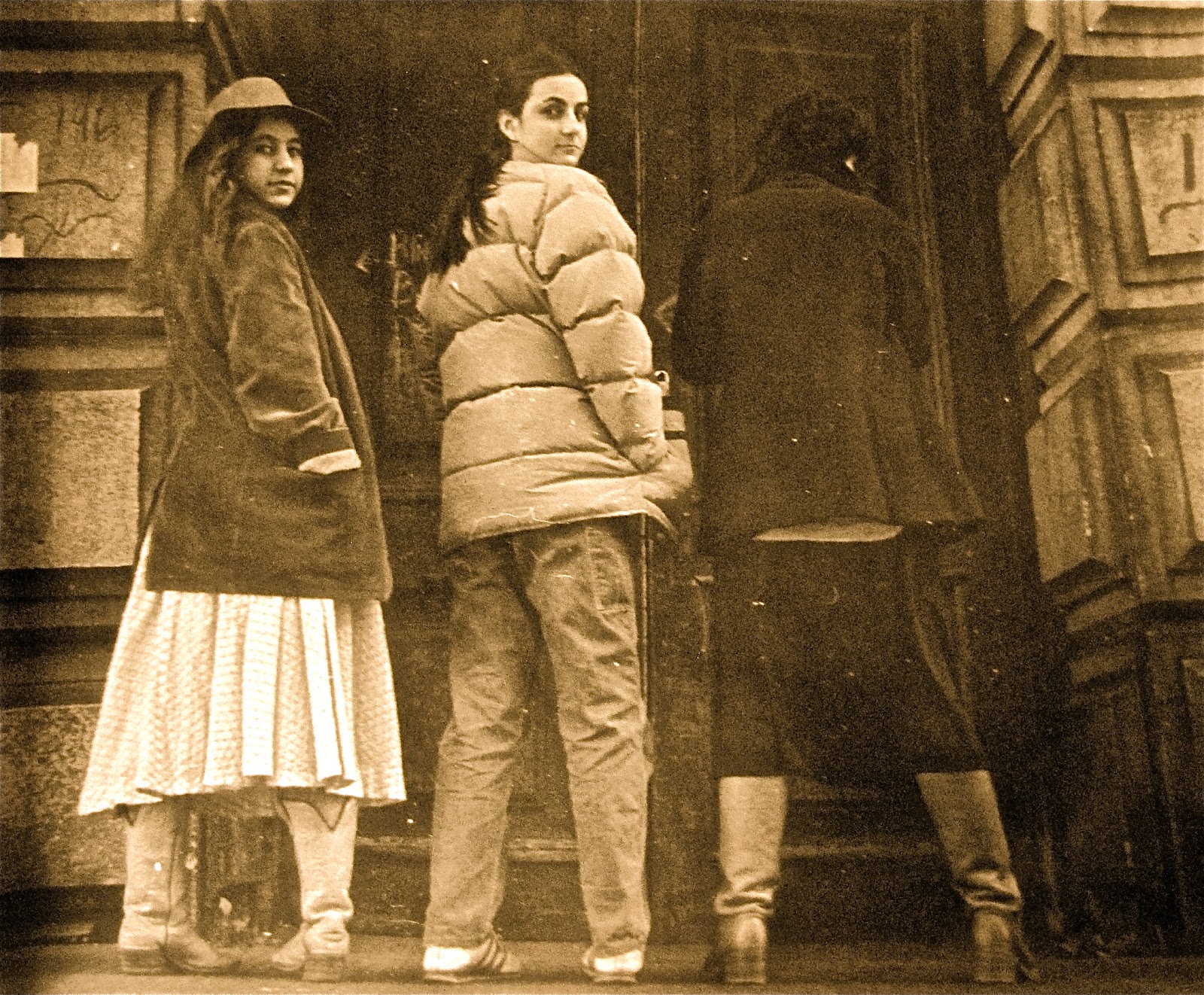
(Click on the pictures to enlarge them.)
I found these photographs not too long ago. They were taken in approximately 1979 when I was 17 years old. In the top photograph I am the one smiling on the left side with the short dark hair, the pea coat, dark skirt and the fry boots. My best friend, whom I'm calling Colette, is on the right side looking up, wearing the hat, the light colored skirt and a pair of her favorite cream colored cowboy boots. The girl in the middle was more of a friend to Colette than to me, but I liked her. These photographs were taken by someone from our high school and the second photograph I think was used in our year book. Unfortunately, I've long since lost that yearbook, but miraculously these photographs, along with a few others, have survived.
This was our senior year and it was around this time that Colette and I, after having been very close for a couple of years, began to move apart from each other and you can see this a bit in our body language. In two of the photographs we are separated by the girl in the middle and in the other photograph we are each in our own world with only Colette making eye contact with the photographer. You wouldn't know that Colette and I had been good friends from these pictures. There's no hugging or leaning against one another or even eye contact. And in the last photograph I have my back to the camera.
I love the way Colette looks in these pictures. By this time she was both a talented modern dancer and a good actress and so she was perceptive, a good mimic, quick and expressive. Here she's dressing in a typical Colette outfit -- the long skirt or sometimes dress, the boots and the hat. I, on the other hand, am not dressed typically here. I rarely wore skirts or dresses or my boots. My uniform was more pants, t-shirt, a man's black jacket, Adidas basketball sneakers. Colette dressed nicely whereas I dressed down. In the City, especially on the subways, I didn't want to draw attention to myself and so I became more androgynous in my look.
The reason I'm posting these pictures, other than giving a few of my friends a chance to see me way back when, is because I decided to reach out to Colette by sending her a link to this blog. I discovered her online about 3 years ago, gathered up several juicy tidbits of information about her, marveled at her success in life and felt badly about myself in comparison to her. I also felt badly that I didn't fight to keep her as a friend because she was a really great friend to me. And then there's my memory which is good in spots and not so good in other spots, probably due to the schizophrenia.
I talked to my friend Rita about contacting Colette by giving Colette a link to my blog. Rita suggested that maybe I should write her an email first and get to know her a little and not spring all this stuff of mine on her. I thought about it and tried writing yet another email (I've written a couple that I never sent), but it didn't feel right. I would rather open myself up to Colette, have her do her own investigation of my blog, artwork and music, in her own time, at her own pace. I also want her to know that she's under no obligation to renew our friendship. I know she's a busy woman with a full life and she may not have the feelings for me that I still have for her.
I want her to know that though I haven't had her success in life, I have been creative and thoughtful. At least I have something to share with her. I know that I am making myself vulnerable before her, but I see that as a form of respect. I hope she enjoys some of what she finds.
Wednesday, April 25, 2012
Approaching 50
I am almost at the mid-century mark; it is a bittersweet victory, but the bitterness grounds the sweetness the way soil grounds the tree. Bitter soil, sweet tree, add some clouds and rain, then top it off with a day full of sunshine, maybe that's what my life comes to so far, something bucolic, seen from a distance, as many years have passed. Up close, it's been a different story; there have been tornadoes and hurricanes and earthquakes...but not for most of this decade, my now receding 40s. These have been my recovery-from-severe-mental-illness years and they have coincided with my middle age.
Most of us don't make it to 100 years old, though I think the statistics on that are changing, and I don't consider 50 "middle age". For me 50 marks the beginning of old age and, in my book, that's a good thing. I see it as a potential to have a second flowering, but it requires that I let go of the first one. For all of us, with the first flowering, we blossomed from child to adolescent to young adult. From adulthood through middle age we began the habit of looking backwards as we lived past our physical and sexual peaks. By the time we get to 50, we have to take a stand, either we fight against the changes of physical aging or we accept ourselves as we are, a person past his or her prime.
I am a person past my prime in my body, but maybe not in my spirit. I accept that with awkwardness instead of graciousness, at least for now. Maybe someday I will let go of identifying myself with my physical appearance and then I will find the graciousness I lack. That's what I'm hoping my 50s will give as a gift, the graciousness to accept myself as I am despite a youth obsessed culture. To many people signs of aging are like signs of falling from grace. Recently I was watching "Up With Chris Hayes" on MSNBC and he mentioned this actress, Ashley Judd, who wrote an op-ed piece in The Daily Beast on the media outcry over the fact that she is an almost 44 year old woman who now looks her age. They vilified her for having a "puffy" face, for no longer being a size 2-4. In my opinion she is still a nice looking woman, but she is no longer young and in her prime.
We are not super action figures and, despite those people who have aged well into their 50s, we are supposed to change, get older and die. These are the facts of life and not about personal failing. But many of us, male and female, take aging on as if we did something wrong, made too many mistakes and are somehow to blame. We fell for the myth of ageless perfection, which none of us actually had, but some of us approached superficially in our bodies. The reality is that perfection is more of a state of mind than an actual thing. We go in and out of perfection. The myth is that we can live outside of aging; the reality is we are tied to each breath we take, to each moment's time and place and to our exact ages.
We are human and as fragile as every living thing is fragile. We take risks, we grow up and maybe we grow old; if we're very fortunate we grow old in relatively good health. For some, seeing the aging process in loved ones or popular media figures is saddening, for others it is just nature coming through, and for still others, there's an appreciation for the person, a genuine fondness for the deepening of character within that individual. But there's one thing I've overlooked and that is fear -- we fear seeing people age because we know it means that someday they will die and then someday we will die. Mostly people in our culture don't have open, healthy discussions about death and so we stay in a denial about it, we say to ourselves, "someday...but not now." Staying in denial is why I think we fixate on youth and youth culture fostering the illusion that we can be invincible in the face of tough odds. But maybe, as people live longer, that will change and we'll move into a more realistic culture that is not afraid to embrace the life cycle.
Physically the life cycle is about birth to the peak of life and then into decline, and finally, into death. Mentally, emotionally and, yes, spiritually, life's transition points are more subtle and complex. I mentioned this idea of having a second flowering after middle age because I have heard stories from people who have lived into their 50s and beyond who have gone through it. Many people describe the great relief they feel as they shed the self-consciousness of their younger years. It becomes less about how you look to yourself and others and more about how fully you experience things. The irony is, the more fully you experience things, the younger you get, obviously not in your body, but in your spirit. As is the way with the flexibility of human nature, some young people think and act old and some older people think and act young.
I've been preparing to turn 50 this whole year. Years ago, when I was acutely ill, the voices told me that I would be very happy in my 50s and 60s. I was in my late 30s then and I was miserable at the thought of having to wait so long. I went head first into middle age and lost even more of my personal illusions. I was no longer young and attractive. I decided against getting romantically involved with anyone. I had to find other ways to value myself and, to a certain extent, I did. I stayed creative from before the beginning of my psychosis till now. This has given me some of my self-esteem back. This blog, through my ups and downs, and through readers, has given me a place to speak out. Here it's not about how I look, it's about what I have to say; it's about working hard to express myself clearly in writing. There's an invisible contract between writer and reader that I try to abide by: be honest, be clear, strive for personal integrity and be respectful of others. I can work with that. That's what it is to be alive and still growing even past one's prime.
Most of us don't make it to 100 years old, though I think the statistics on that are changing, and I don't consider 50 "middle age". For me 50 marks the beginning of old age and, in my book, that's a good thing. I see it as a potential to have a second flowering, but it requires that I let go of the first one. For all of us, with the first flowering, we blossomed from child to adolescent to young adult. From adulthood through middle age we began the habit of looking backwards as we lived past our physical and sexual peaks. By the time we get to 50, we have to take a stand, either we fight against the changes of physical aging or we accept ourselves as we are, a person past his or her prime.
I am a person past my prime in my body, but maybe not in my spirit. I accept that with awkwardness instead of graciousness, at least for now. Maybe someday I will let go of identifying myself with my physical appearance and then I will find the graciousness I lack. That's what I'm hoping my 50s will give as a gift, the graciousness to accept myself as I am despite a youth obsessed culture. To many people signs of aging are like signs of falling from grace. Recently I was watching "Up With Chris Hayes" on MSNBC and he mentioned this actress, Ashley Judd, who wrote an op-ed piece in The Daily Beast on the media outcry over the fact that she is an almost 44 year old woman who now looks her age. They vilified her for having a "puffy" face, for no longer being a size 2-4. In my opinion she is still a nice looking woman, but she is no longer young and in her prime.
We are not super action figures and, despite those people who have aged well into their 50s, we are supposed to change, get older and die. These are the facts of life and not about personal failing. But many of us, male and female, take aging on as if we did something wrong, made too many mistakes and are somehow to blame. We fell for the myth of ageless perfection, which none of us actually had, but some of us approached superficially in our bodies. The reality is that perfection is more of a state of mind than an actual thing. We go in and out of perfection. The myth is that we can live outside of aging; the reality is we are tied to each breath we take, to each moment's time and place and to our exact ages.
We are human and as fragile as every living thing is fragile. We take risks, we grow up and maybe we grow old; if we're very fortunate we grow old in relatively good health. For some, seeing the aging process in loved ones or popular media figures is saddening, for others it is just nature coming through, and for still others, there's an appreciation for the person, a genuine fondness for the deepening of character within that individual. But there's one thing I've overlooked and that is fear -- we fear seeing people age because we know it means that someday they will die and then someday we will die. Mostly people in our culture don't have open, healthy discussions about death and so we stay in a denial about it, we say to ourselves, "someday...but not now." Staying in denial is why I think we fixate on youth and youth culture fostering the illusion that we can be invincible in the face of tough odds. But maybe, as people live longer, that will change and we'll move into a more realistic culture that is not afraid to embrace the life cycle.
Physically the life cycle is about birth to the peak of life and then into decline, and finally, into death. Mentally, emotionally and, yes, spiritually, life's transition points are more subtle and complex. I mentioned this idea of having a second flowering after middle age because I have heard stories from people who have lived into their 50s and beyond who have gone through it. Many people describe the great relief they feel as they shed the self-consciousness of their younger years. It becomes less about how you look to yourself and others and more about how fully you experience things. The irony is, the more fully you experience things, the younger you get, obviously not in your body, but in your spirit. As is the way with the flexibility of human nature, some young people think and act old and some older people think and act young.
I've been preparing to turn 50 this whole year. Years ago, when I was acutely ill, the voices told me that I would be very happy in my 50s and 60s. I was in my late 30s then and I was miserable at the thought of having to wait so long. I went head first into middle age and lost even more of my personal illusions. I was no longer young and attractive. I decided against getting romantically involved with anyone. I had to find other ways to value myself and, to a certain extent, I did. I stayed creative from before the beginning of my psychosis till now. This has given me some of my self-esteem back. This blog, through my ups and downs, and through readers, has given me a place to speak out. Here it's not about how I look, it's about what I have to say; it's about working hard to express myself clearly in writing. There's an invisible contract between writer and reader that I try to abide by: be honest, be clear, strive for personal integrity and be respectful of others. I can work with that. That's what it is to be alive and still growing even past one's prime.
Wednesday, April 18, 2012
How Psychotic Am I?
Statement: I believe that the voices that I hear within my mind are from a real and highly intelligent source and are not audio hallucinations.
Psychiatrists and some therapists would probably say that I am deluded about my audio hallucinations. They would say that I am psychotic, though no longer acutely so.
So how psychotic am I? How much of what I write about has common sense intelligence in it and how much is just off the wall insanity? I'm hoping that most people can follow my thought process in my writing, that I come across as basically sane, even trustworthy. I hope for that because I want to be of help to others and I can't do that if I'm not making sense. So I don't write about my voices much because I know to do so would be to lose what small credibility I have to begin with. Now that I think of it, this is misleading because I am leaving out a key ingredient of my daily experience.
There are people who hear voices who are not psychotic and those that don't hear voices who are psychotic. I started out hearing voices before I became delusional and paranoid and they were basically non harming and even helpful. It's when the voices became intrusive and manipulative that I quickly became psychotic. I believed in the delusions and paranoia and the voices took on many roles from sadistic to benevolent. While I was acutely psychotic I interacted with the voices in a way that I no longer do. The medications appear to have given me some distance from them and a sense of quiet space to reflect on my daily experiences. But even with the distance, the voices are another layer of awareness in addition to my own awareness; I know I am never alone in my mind and experience.
I'm assuming that those of you who don't hear voices must take that last sentence and dismiss it as not real. That's too bad because then you can't see into my world or rather what you do see is just a fraction of what is there. If you were brave enough to suspend your disbelief and consider what it means to have voices that are not audio hallucinations, what would you find? You tell me.
The voices are as constant to me as the rising and setting of the sun and as real as the blue sky that always resides behind the clouds. But like the mind, they have no visible substance. There is no concrete proof that these voices that I hear come from actual beings. But if there were proof what would it mean for the consciousness of the whole world? It would mean different things for different people. Finally, we would have to stop imagining ourselves as alone in the universe. But that these beings could somehow enter into our collective consciousness and into individual minds might not be so reassuring especially when the messengers are the mentally ill.
Am I doing people who believe their voices are audio hallucinations a disservice? Shouldn't I be saying to them it's all just a genetic defect, a biochemical glitch? I do believe that genetics and biochemistry are involved in developing psychotic disorders, but I would not be being honest if I said that that was the end of the story; being honest is what keeps me in recovery. I can't lie about what I feel in my bones is true, but I have long since given up trying to prove my belief. I can't prove it and it's been a relief to stop trying. I've found that the people who are most sick are the ones who obsess on trying to prove their position. At some point, you have to let go. Letting go is a spiritual practice.
Still I believe that mental illness and recovery from mental illness is a psycho-spiritual process, one that requires that you stand up for yourself. If you don't stand up for yourself, for your basic goodness, there's a good chance that you could be swallowed whole by the negative aspects of the illness. Too many people turn to suicide or other forms of self-harm and many of those people wind up in and out of psychiatric hospitals or wards unable to live independently for any length of time. If you have negative voices, you must search out the positive even within the negative. My voices have called me evil so many times, but I rarely believed it, which is why I am still alive. I said "No" to the voices assessment of me and yet I didn't harden myself against them. I learned to cultivate compassion for myself, others and for them.
I did acknowledge to myself that I was sick and in need of help and I found a therapist within the first 6 months. She taught me to see the negative voices as much sicker than myself. This helped a lot. Instead of internalizing the core of the sickness, hurting myself and possibly others, I learned to detach and defend the part of me I loved. Initially I felt a lot of resentment towards the negative voices, but overtime, using the gentle practice of compassion, this changed and the voices returned to being mostly non-harming, even beneficial. They still act up, especially when I get anxious, but I have changed my perspective on why they act up. I try to see them as teachers and work with them instead of against them and myself.
Chris had asked me the question in one of her comments to a blog entry of mine "Would you really want to hear voices if you didn't have to?" I honestly don't know. I've lived with the voices for so long now, through thick and thin, and I have trouble envisioning life without them. The medications do not remove the voices for me and if they can't do it, what will? So I assume that they are with me for life and I have to adapt to their presence. In accepting their presence in my life, I have come to appreciate what is good about them. They are intelligent, creative, supportive and from time to time I really commune with them in a way that I don't commune with others. They represent the whole spectrum of The Unknown. In my heart of hearts, I believe that they are ultimately trying to help this world by working with people, individual by individual.
Anyway, this belief that the voices come from a real source outside of me is what makes some people deem me psychotic. So be it. But don't tell me that I don't make a helluvalot of sense sometimes. And how can that be that I am both psychotic and sensible? Some might say that there's method in madness, but I'm here to say that there's truth in madness as well. Don't ever discount the truth when you find it. I'm here to challenge you to stay openminded. I may not be able to prove that God exists, or angels and devils, or spirits, or aliens, but, on the other hand, you can't prove that they don't exist either. There's more than meets the eye for all of our lives. The mystery continues every day.
Psychiatrists and some therapists would probably say that I am deluded about my audio hallucinations. They would say that I am psychotic, though no longer acutely so.
So how psychotic am I? How much of what I write about has common sense intelligence in it and how much is just off the wall insanity? I'm hoping that most people can follow my thought process in my writing, that I come across as basically sane, even trustworthy. I hope for that because I want to be of help to others and I can't do that if I'm not making sense. So I don't write about my voices much because I know to do so would be to lose what small credibility I have to begin with. Now that I think of it, this is misleading because I am leaving out a key ingredient of my daily experience.
There are people who hear voices who are not psychotic and those that don't hear voices who are psychotic. I started out hearing voices before I became delusional and paranoid and they were basically non harming and even helpful. It's when the voices became intrusive and manipulative that I quickly became psychotic. I believed in the delusions and paranoia and the voices took on many roles from sadistic to benevolent. While I was acutely psychotic I interacted with the voices in a way that I no longer do. The medications appear to have given me some distance from them and a sense of quiet space to reflect on my daily experiences. But even with the distance, the voices are another layer of awareness in addition to my own awareness; I know I am never alone in my mind and experience.
I'm assuming that those of you who don't hear voices must take that last sentence and dismiss it as not real. That's too bad because then you can't see into my world or rather what you do see is just a fraction of what is there. If you were brave enough to suspend your disbelief and consider what it means to have voices that are not audio hallucinations, what would you find? You tell me.
The voices are as constant to me as the rising and setting of the sun and as real as the blue sky that always resides behind the clouds. But like the mind, they have no visible substance. There is no concrete proof that these voices that I hear come from actual beings. But if there were proof what would it mean for the consciousness of the whole world? It would mean different things for different people. Finally, we would have to stop imagining ourselves as alone in the universe. But that these beings could somehow enter into our collective consciousness and into individual minds might not be so reassuring especially when the messengers are the mentally ill.
Am I doing people who believe their voices are audio hallucinations a disservice? Shouldn't I be saying to them it's all just a genetic defect, a biochemical glitch? I do believe that genetics and biochemistry are involved in developing psychotic disorders, but I would not be being honest if I said that that was the end of the story; being honest is what keeps me in recovery. I can't lie about what I feel in my bones is true, but I have long since given up trying to prove my belief. I can't prove it and it's been a relief to stop trying. I've found that the people who are most sick are the ones who obsess on trying to prove their position. At some point, you have to let go. Letting go is a spiritual practice.
Still I believe that mental illness and recovery from mental illness is a psycho-spiritual process, one that requires that you stand up for yourself. If you don't stand up for yourself, for your basic goodness, there's a good chance that you could be swallowed whole by the negative aspects of the illness. Too many people turn to suicide or other forms of self-harm and many of those people wind up in and out of psychiatric hospitals or wards unable to live independently for any length of time. If you have negative voices, you must search out the positive even within the negative. My voices have called me evil so many times, but I rarely believed it, which is why I am still alive. I said "No" to the voices assessment of me and yet I didn't harden myself against them. I learned to cultivate compassion for myself, others and for them.
I did acknowledge to myself that I was sick and in need of help and I found a therapist within the first 6 months. She taught me to see the negative voices as much sicker than myself. This helped a lot. Instead of internalizing the core of the sickness, hurting myself and possibly others, I learned to detach and defend the part of me I loved. Initially I felt a lot of resentment towards the negative voices, but overtime, using the gentle practice of compassion, this changed and the voices returned to being mostly non-harming, even beneficial. They still act up, especially when I get anxious, but I have changed my perspective on why they act up. I try to see them as teachers and work with them instead of against them and myself.
Chris had asked me the question in one of her comments to a blog entry of mine "Would you really want to hear voices if you didn't have to?" I honestly don't know. I've lived with the voices for so long now, through thick and thin, and I have trouble envisioning life without them. The medications do not remove the voices for me and if they can't do it, what will? So I assume that they are with me for life and I have to adapt to their presence. In accepting their presence in my life, I have come to appreciate what is good about them. They are intelligent, creative, supportive and from time to time I really commune with them in a way that I don't commune with others. They represent the whole spectrum of The Unknown. In my heart of hearts, I believe that they are ultimately trying to help this world by working with people, individual by individual.
Anyway, this belief that the voices come from a real source outside of me is what makes some people deem me psychotic. So be it. But don't tell me that I don't make a helluvalot of sense sometimes. And how can that be that I am both psychotic and sensible? Some might say that there's method in madness, but I'm here to say that there's truth in madness as well. Don't ever discount the truth when you find it. I'm here to challenge you to stay openminded. I may not be able to prove that God exists, or angels and devils, or spirits, or aliens, but, on the other hand, you can't prove that they don't exist either. There's more than meets the eye for all of our lives. The mystery continues every day.
Friday, April 13, 2012
The Key Ingredient
Karen, Chris, Juju and Jen, thank you for your comments! All of you amaze me! You are all so smart, talented, hardworking and sensitive, despite what life has thrown at you. What a great group; it's a pleasure to be connected to you. And in a wonderful and serendipitous fashion you represent the whole spectrum of the issue. Chris and Jen are anti anti-psychiatry, Juju sees value in both approaches and Karen has personally entered into reducing her medications, though very gradually, and is exploring the possibility of someday being medication free. And you know what? You are all right in your perspectives for your particular case.
Chris is symptom free and considers herself recovered. She is one of the fortunate ones; the medications seem to have given her her life back. Jen went through years of hellish experience with her psychosis until she had a five month stay in a hospital where she began to take the medications for an extended period of time. Gradually she has gotten her life back too and is in the process of becoming a social worker so she can use her personal experience and know-how to help other people (which she already does in her mental health advocacy work). They both readily believe that it is the medication that has saved them and given them back the opportunity to have a full life. I really do believe that part of the reason for their personal successes is due to taking the medications, but I must point out to them and to all who read this blog, that they are overlooking one key ingredient: themselves.
They are both ambitious women who are motivated by their desire to help others. They have both done a ton of research over time on mental illness, especially on schizophrenia and schizoaffective disorder. Because they live in populous areas, they've had access to quite a few mental health resources and being who they are, strong women who wanted to take care of themselves, they took full advantage of those resources. They not only took their medications faithfully, they got therapy, went to support groups, got vocational training and became serious advocates for mental health in the places they live and online. They are one kind of success story and if you are like them, ambitious and very hardworking, and if your biochemistry responds to the medications and if you have the resources near you, I think you have just as good a chance as they did of finding personal success. I have so much respect for both of them and I think they are doing the right things in their life. There is no doubt in my mind that they will go far in life and help a lot of people.
But I'm starting to get the feeling that there are other success stories out there, success stories for people who don't respond to the medications or who are brave enough to attempt to reduce their medications, with the proper support. We need all the help we can get, and if there are alternatives to using the medications, my God, wouldn't you want that? Especially for those who don't respond to the medications? We are all the same and yet we are all different. We need to be pro-choice and never rule out the things we find that work for even the smallest percentage. A small percentage of people who currently have mental illness in the world is in the millions! Everybody must be welcome, everybody must be helped. I don't think it is wise to take too strong a position (though I might be trying to do just that--ha!) because a one-sided opinion is actually a weak position. To survive and thrive we have to be flexible, in mild winds or in hurricane winds. Polarization works at keeping things polarized and the only real outcome to that is civil war. And when that happens, people forget that we are all brothers and sisters on this planet. Does that sound corny? Well, I don't care because it's a big truth that too many of us ignore.
So I've written about Chris and Jen's story and given my response. But what about Karen and Juju? Karen is also an ambitious woman and a strong woman, like Chris and Jen, and like them she is a writer, but she is also a visual artist. Her illness has restricted her for many years and she's learned to cope using both the medications, seeing a therapist and going to a support group (which she has also lead). She is very smart and insightful and very dedicated to her art work. Because she is so dedicated, it is important to her to be as sensitive, yet balanced, as possible. After reading several books that challenged the so-called "medical model" of the need to be medication compliant, she began to consider reducing her medications to see if she could become more sensitive in her life and with her work. In her system of priorities, being the best artist she can be is on the top of the list, even to the point of risking a return of symptoms. Some people might call her foolish, but I think she's brave. The main reason why I think she is brave and not foolish, is that she has a support system in place with her husband and therapist, with whom she is quite close. She also agreed to return to taking the medications if her symptoms returned enough to require hospitalization. And most importantly, in my opinion, she is staying vigilant to any and all changes, either for the better or the worse. So far, on a reduced dosage of her medications, she is feeling better and not worse, but if I know Karen, she does not take that for granted. She is no fool. She also just wants to be happy, just like all of us and she likes a good challenge.
I, not only respect Karen, I identify with her because I am also a writer, an artist of sorts and a song writer. I know some of where she's coming from and I just think she has a fine and sensitive heart and mind. I want her to be very happy, which is why I want to be supportive of her decision to reduce and maybe eventually stop using the medications in conjunction with other alternative therapies (if possible). So far she's had some success and if that continues it can only be good news, not only for her, but for people like me who want to learn from what works out there. She's put herself in the frontier of people risking themselves to test out different approaches to their mental illnesses. I don't have her courage, not yet anyway, which is why I look up to her. I'm also way too ignorant and have a lot of research and studying to do, as well as feeling out what it is I want to do in my heart/mind. And if Karen's experiment doesn't work for her, I'm sure she will be creative in finding out what will. I know she can rely on her ability to be honest with herself. Either way, success or "failure", I'll be in her corner. She's the one who's really taking the risk here and she's not hurting anyone else in order to do it.
And Juju? Juju is in the heartbreaking and sometimes maddening situation of being all she can be for her young son who suffers from schizophrenia. He's lived with the symptoms of this illness since I believe he was twelve years old and now he is eighteen. I only met Juju because she reached out to me and let me know about her blog which she just started in March. She strikes me as a real, smart mama lion trying to take care of her wounded cub. Her position is one of seeking any and all solutions or partial treatments to help her son. And what is she, too? A strong and ambitious woman who is also willing to go the distance for herself, her son, her family and her community. In the comments section of my last blog post, she gave the best advice: "Do what you need to do to be the best you you can be." Now that goes for anyone.
So what's the key ingredient for all these women and for me and for you? Our own sweet (and not so sweet, if we're honest) selves. If there's a will, there's a way. You have to believe in your self and love yourself. And here's some more corny writing: you have to be your own best friend. There's a Buddhist mind training slogan that goes, "Of the two witnesses, hold to the principal one." Pema Chodron says of this slogan in her excellent book "Start Where You Are", that the "one witness is everybody else giving you their feedback and opinions (which are worth listening to; there's some truth in what people say), but the principal witness is yourself. You're the only one who knows when you're opening and when you're closing. You're the only one who knows when you're using things to protect yourself and keep your ego together and when you're opening and letting things fall apart, letting the world come as it is -- working with it rather than struggling against it. You're the only one who knows." (p. 146)
My challenge to you now and always is to be super honest with yourself while at the same time being super kind to yourself. You don't have to be a superwoman or a superman, you just have to tell it like it is. Stop running. Study yourself. See what works and what doesn't work. Learn from your mistakes. Trust yourself. And if you're able to, and you know that you are, play fair with others, not just some of the time, aim for all of the time. If you do, gradually (or maybe even quickly for some) the world will change for the better. Guaranteed. Let's give peace a chance and lets use our hearts and minds together to find the solutions that are within reach, for all of us and not for just some.
Chris is symptom free and considers herself recovered. She is one of the fortunate ones; the medications seem to have given her her life back. Jen went through years of hellish experience with her psychosis until she had a five month stay in a hospital where she began to take the medications for an extended period of time. Gradually she has gotten her life back too and is in the process of becoming a social worker so she can use her personal experience and know-how to help other people (which she already does in her mental health advocacy work). They both readily believe that it is the medication that has saved them and given them back the opportunity to have a full life. I really do believe that part of the reason for their personal successes is due to taking the medications, but I must point out to them and to all who read this blog, that they are overlooking one key ingredient: themselves.
They are both ambitious women who are motivated by their desire to help others. They have both done a ton of research over time on mental illness, especially on schizophrenia and schizoaffective disorder. Because they live in populous areas, they've had access to quite a few mental health resources and being who they are, strong women who wanted to take care of themselves, they took full advantage of those resources. They not only took their medications faithfully, they got therapy, went to support groups, got vocational training and became serious advocates for mental health in the places they live and online. They are one kind of success story and if you are like them, ambitious and very hardworking, and if your biochemistry responds to the medications and if you have the resources near you, I think you have just as good a chance as they did of finding personal success. I have so much respect for both of them and I think they are doing the right things in their life. There is no doubt in my mind that they will go far in life and help a lot of people.
But I'm starting to get the feeling that there are other success stories out there, success stories for people who don't respond to the medications or who are brave enough to attempt to reduce their medications, with the proper support. We need all the help we can get, and if there are alternatives to using the medications, my God, wouldn't you want that? Especially for those who don't respond to the medications? We are all the same and yet we are all different. We need to be pro-choice and never rule out the things we find that work for even the smallest percentage. A small percentage of people who currently have mental illness in the world is in the millions! Everybody must be welcome, everybody must be helped. I don't think it is wise to take too strong a position (though I might be trying to do just that--ha!) because a one-sided opinion is actually a weak position. To survive and thrive we have to be flexible, in mild winds or in hurricane winds. Polarization works at keeping things polarized and the only real outcome to that is civil war. And when that happens, people forget that we are all brothers and sisters on this planet. Does that sound corny? Well, I don't care because it's a big truth that too many of us ignore.
So I've written about Chris and Jen's story and given my response. But what about Karen and Juju? Karen is also an ambitious woman and a strong woman, like Chris and Jen, and like them she is a writer, but she is also a visual artist. Her illness has restricted her for many years and she's learned to cope using both the medications, seeing a therapist and going to a support group (which she has also lead). She is very smart and insightful and very dedicated to her art work. Because she is so dedicated, it is important to her to be as sensitive, yet balanced, as possible. After reading several books that challenged the so-called "medical model" of the need to be medication compliant, she began to consider reducing her medications to see if she could become more sensitive in her life and with her work. In her system of priorities, being the best artist she can be is on the top of the list, even to the point of risking a return of symptoms. Some people might call her foolish, but I think she's brave. The main reason why I think she is brave and not foolish, is that she has a support system in place with her husband and therapist, with whom she is quite close. She also agreed to return to taking the medications if her symptoms returned enough to require hospitalization. And most importantly, in my opinion, she is staying vigilant to any and all changes, either for the better or the worse. So far, on a reduced dosage of her medications, she is feeling better and not worse, but if I know Karen, she does not take that for granted. She is no fool. She also just wants to be happy, just like all of us and she likes a good challenge.
I, not only respect Karen, I identify with her because I am also a writer, an artist of sorts and a song writer. I know some of where she's coming from and I just think she has a fine and sensitive heart and mind. I want her to be very happy, which is why I want to be supportive of her decision to reduce and maybe eventually stop using the medications in conjunction with other alternative therapies (if possible). So far she's had some success and if that continues it can only be good news, not only for her, but for people like me who want to learn from what works out there. She's put herself in the frontier of people risking themselves to test out different approaches to their mental illnesses. I don't have her courage, not yet anyway, which is why I look up to her. I'm also way too ignorant and have a lot of research and studying to do, as well as feeling out what it is I want to do in my heart/mind. And if Karen's experiment doesn't work for her, I'm sure she will be creative in finding out what will. I know she can rely on her ability to be honest with herself. Either way, success or "failure", I'll be in her corner. She's the one who's really taking the risk here and she's not hurting anyone else in order to do it.
And Juju? Juju is in the heartbreaking and sometimes maddening situation of being all she can be for her young son who suffers from schizophrenia. He's lived with the symptoms of this illness since I believe he was twelve years old and now he is eighteen. I only met Juju because she reached out to me and let me know about her blog which she just started in March. She strikes me as a real, smart mama lion trying to take care of her wounded cub. Her position is one of seeking any and all solutions or partial treatments to help her son. And what is she, too? A strong and ambitious woman who is also willing to go the distance for herself, her son, her family and her community. In the comments section of my last blog post, she gave the best advice: "Do what you need to do to be the best you you can be." Now that goes for anyone.
So what's the key ingredient for all these women and for me and for you? Our own sweet (and not so sweet, if we're honest) selves. If there's a will, there's a way. You have to believe in your self and love yourself. And here's some more corny writing: you have to be your own best friend. There's a Buddhist mind training slogan that goes, "Of the two witnesses, hold to the principal one." Pema Chodron says of this slogan in her excellent book "Start Where You Are", that the "one witness is everybody else giving you their feedback and opinions (which are worth listening to; there's some truth in what people say), but the principal witness is yourself. You're the only one who knows when you're opening and when you're closing. You're the only one who knows when you're using things to protect yourself and keep your ego together and when you're opening and letting things fall apart, letting the world come as it is -- working with it rather than struggling against it. You're the only one who knows." (p. 146)
My challenge to you now and always is to be super honest with yourself while at the same time being super kind to yourself. You don't have to be a superwoman or a superman, you just have to tell it like it is. Stop running. Study yourself. See what works and what doesn't work. Learn from your mistakes. Trust yourself. And if you're able to, and you know that you are, play fair with others, not just some of the time, aim for all of the time. If you do, gradually (or maybe even quickly for some) the world will change for the better. Guaranteed. Let's give peace a chance and lets use our hearts and minds together to find the solutions that are within reach, for all of us and not for just some.
Tuesday, April 10, 2012
Parallels With My Anti-Psychiatry Peers
I have come upon the anti-psychiatry movement late. I've only just started reading some blogs about it. There's a lot of outcry about the perils of being medicated, some of which I certainly sympathize with, but what I was really looking for was a list of alternatives to taking the medications. I just found one large site with lots and lots of information on it, it's called Beyond Meds: Alternatives to Psychiatry. I've only read a bit of it, but plan to return and continue my research. I was fascinated to find that I have been going on a parallel course because some of the alternatives that are suggested are Mindfulness, Meditation, Yoga and viewing one's illness as actually a psycho-spiritual journey. On one of the sites that I stopped at they even were pushing books by Adyashanti! I also read an article by a woman who suffered from Bi-Polar disorder who came to embrace Tibetan Buddhism and mind training, while working in a peer-run support group and not taking the medications.
In terms of spiritual orientation these anti-psychiatry people appear to by "my" people. I certainly do accept them as such because we have been to the same hard places. And I am all for exploring alternatives to the medications. If people don't explore, they will never find ways to develop better treatments to complex psychotic illnesses. And without exploration, there's not even the possibility of discovering a cure. It seems more and more likely that community outreach programs and peer run support groups will be the wave of the future. God, I hope so. I know I was meant to be a part of a mental health support group. The great thing about support groups is that everyone is welcome from the acutely ill to those in partial recovery to those in full recovery. There's so much we can learn from one another, but we have to get into each other's hearts and minds and learn how to be there for each other.
I want to believe that following a spiritual path of being Mindful and training the mind to study itself without judgment could help to treat acute psychosis. I want to believe the same for Cognitive Behavioral Therapy and peer run support groups and diet, nutrition and exercise programs, but I honestly don't know yet. Maybe individualized combinations of treatments could really address the core symptoms enough to treat acute psychosis without medication or with medication at a very small dosage. All I know is that people need to get organized and that's what the anti-psychiatry movement appears to be doing, working both in communities and online. I know I need the help in my community; medication and individual therapy have not been enough for me -- I need to meet peers face to face. I've felt frustration about this for so long and disappointment in myself for not having the courage and stamina to start up a support group in my town. I'm hoping this will change this year. I talk a good game about peer support because I got so much out of going to the Al-Anon group, but the group is just not appropriate from people with psychotic disorders.
And I do use the word "psychotic" and "disorders" as well as the word "schizophrenia" because I do see the phenomenon of psychosis as an expression of imbalance and illness, though I know it can be a means to personal growth; it can also lead to suicide. As I wrote in my last post, it is the people in the thrall of acute psychosis who most concern me and that is why I still believe that medication should be an option at least for a period of time. At the same time, I'm all for engaging individuals in various forms of treatment in addition to the medications. Build a support network, and work on your own, too, while taking advantage of what the medications can do for you and then decide whether to continue with the medications or not. The medications are imperfect; there's no doubt about that, but it's important to use as many options as you can, especially when you are suffering so much.
If I find that there are viable alternatives to medications, ones that really work to treat psychosis, I think I might consider reducing my medications, mainly because I'm on high doses and have been for 10 years and I don't know if that's good for me or not. I'm still afraid of falling back into acute illness. Most of my days have challenges in them. I am not recovered, but I will continue to wave the flag of RECOVERY for any newcomers. Recovery, in all its forms and gradations, is possible. That's very important to realize. No matter how bad it gets, and it can get pretty bad, you will not be stuck in a hellish place indefinitely, but you do need to motivate yourself to reach out to others, to share your story and to do what you need to do in order to take care of yourself.
The most important point I can make here is that we, who have suffered from psychotic disorders, are all peers regardless of whether we take the medications or try an alternative route. We need to stand united or at least make bridges to meet each other across the sometimes great divide. I deeply appreciate people on both sides, but really, we are the same with similar stuggles and successes. Today I read a blog entry by Charles on his blog Mental Health Recovery and in it he writes about how you have to let go of blaming in order to recover and to "be positive in the face of negativity". I think we've got to work to understand each other better and learn to be extremely tolerant of just those people who cause us to feel self-protective and defensive. Check yourself out and see what you find. I find the problem is usually within my own self and that I have a lot to learn from different people and points of view.
In terms of spiritual orientation these anti-psychiatry people appear to by "my" people. I certainly do accept them as such because we have been to the same hard places. And I am all for exploring alternatives to the medications. If people don't explore, they will never find ways to develop better treatments to complex psychotic illnesses. And without exploration, there's not even the possibility of discovering a cure. It seems more and more likely that community outreach programs and peer run support groups will be the wave of the future. God, I hope so. I know I was meant to be a part of a mental health support group. The great thing about support groups is that everyone is welcome from the acutely ill to those in partial recovery to those in full recovery. There's so much we can learn from one another, but we have to get into each other's hearts and minds and learn how to be there for each other.
I want to believe that following a spiritual path of being Mindful and training the mind to study itself without judgment could help to treat acute psychosis. I want to believe the same for Cognitive Behavioral Therapy and peer run support groups and diet, nutrition and exercise programs, but I honestly don't know yet. Maybe individualized combinations of treatments could really address the core symptoms enough to treat acute psychosis without medication or with medication at a very small dosage. All I know is that people need to get organized and that's what the anti-psychiatry movement appears to be doing, working both in communities and online. I know I need the help in my community; medication and individual therapy have not been enough for me -- I need to meet peers face to face. I've felt frustration about this for so long and disappointment in myself for not having the courage and stamina to start up a support group in my town. I'm hoping this will change this year. I talk a good game about peer support because I got so much out of going to the Al-Anon group, but the group is just not appropriate from people with psychotic disorders.
And I do use the word "psychotic" and "disorders" as well as the word "schizophrenia" because I do see the phenomenon of psychosis as an expression of imbalance and illness, though I know it can be a means to personal growth; it can also lead to suicide. As I wrote in my last post, it is the people in the thrall of acute psychosis who most concern me and that is why I still believe that medication should be an option at least for a period of time. At the same time, I'm all for engaging individuals in various forms of treatment in addition to the medications. Build a support network, and work on your own, too, while taking advantage of what the medications can do for you and then decide whether to continue with the medications or not. The medications are imperfect; there's no doubt about that, but it's important to use as many options as you can, especially when you are suffering so much.
If I find that there are viable alternatives to medications, ones that really work to treat psychosis, I think I might consider reducing my medications, mainly because I'm on high doses and have been for 10 years and I don't know if that's good for me or not. I'm still afraid of falling back into acute illness. Most of my days have challenges in them. I am not recovered, but I will continue to wave the flag of RECOVERY for any newcomers. Recovery, in all its forms and gradations, is possible. That's very important to realize. No matter how bad it gets, and it can get pretty bad, you will not be stuck in a hellish place indefinitely, but you do need to motivate yourself to reach out to others, to share your story and to do what you need to do in order to take care of yourself.
The most important point I can make here is that we, who have suffered from psychotic disorders, are all peers regardless of whether we take the medications or try an alternative route. We need to stand united or at least make bridges to meet each other across the sometimes great divide. I deeply appreciate people on both sides, but really, we are the same with similar stuggles and successes. Today I read a blog entry by Charles on his blog Mental Health Recovery and in it he writes about how you have to let go of blaming in order to recover and to "be positive in the face of negativity". I think we've got to work to understand each other better and learn to be extremely tolerant of just those people who cause us to feel self-protective and defensive. Check yourself out and see what you find. I find the problem is usually within my own self and that I have a lot to learn from different people and points of view.
Tuesday, April 3, 2012
Why I Am Medication Compliant
There's been a lot of writing in this corner of the blogosphere about medication compliance versus the anti-psychiatry movement; I want to share my perspective on this. First of all, we are all individuals with varying biochemistry and varying temperaments and what works for one person may or may not work for another. There is no absolute right and absolute wrong here. We each have to find our way through our mental illness and beyond into recovery and, as I've said before, there are over 10 percent of us who don't survive the acute stage or early recovery stage. I don't know the percentages, but there are those of us who don't respond to the anti-psychotic medications or who have such bad side effects that it is nearly impossible to take them. I venture to say that most of us fall into the category of being helped by the medications though not free of all symptoms. And then there are the blessed minority who lose all their symptoms primarily due to taking the medications. I am somewhere in the middle. Most of my delusions and paranoia have gone, but I continue to have voices and bouts of depression and anxiety. I have been taking the medications faithfully for a decade and in the interim I have gotten obese and to a lesser extent sexually dysfunctional. I have told myself that since I am a middle aged woman living alone that these side effects are not too much to bear to have most of my sanity intact. Being fat really does bother me and I still have hopes that I can reduce my weight. I haven't completely given up.
But what if I were a young person? Would it be worth it to put on tons of weight and become somewhat impotent? It all depends on how ill one is. If you are so consumed by delusions and paranoia to the point where you have several psychotic breaks I would say that yes, it is worth it. But it is not that simple. First you have to commit to taking the medication for at least a year, probably making medication adjustments till you find the best combination. These are potent drugs and it takes time to adjust to having them in your system. I would never have entered into the recovery stage if I hadn't had a whole lot of patience while trying to find what worked best for me. After I did find the right combination, I would have years of struggling with depression and later anxiety. I'm not going to kid you, recovery takes years not months, though it seems to me that the earlier you catch it and treat it the better the prognosis is for the long term. That's for those who respond to the medications and the only way you find that out is by consistently taking them over an extended period of time. When I first became acutely ill my psychiatrist gave me a lot of free samples of anti-psychotic medications to try because I didn't have insurance. I had three breakdowns in three and a half years and each time I fell I would try taking some of the medication, but I would always stop after a few weeks or a month. I dabbled in it and that did me no good. If you're going to do, do it, commit to it, test it out, see which medications reduce your symptoms the best.
There are several reasons why I am faithful to taking the medications despite the side effects. The most basic motivation for me is fear. Only those who have crossed over repeatedly into insanity know how disorienting and frightening it is to lose one's mind amidst the onslaught of psychotic thoughts and feelings. While I was in it I really felt as if I were being psychically crucified. I was figuratively lost at sea with no sign of help on the way. I was in so much pain. I lived in a twilight zone with maybe one foot tentatively in reality and the rest of me consumed by illusions. I was battered by repeated breakdowns and the further along I went in that direction, the closer I got to yearning for death. The medications gave me an opening, a window away from death and back towards life. I took that chance. I compromised. I knew one thing clearly, I never wanted to return to a life of acute psychosis and I was willing to go the distance. I'm here to tell you that I am so glad that I did. My life is not perfect, but it is solidly good. I am grateful to be alive, even when I'm suffering. I no longer feel as if I'm on trial waiting for the jury to come back with their decision -- life in hell or a second chance at becoming a better human being with the odds tipping against me. The medication is part of why I have beat the odds.
Another reason why I take the medications is to reassure not only myself, but my loved ones and society at large that I am doing everything possible to treat my illness. I see it as accepting responsibility for myself and taking care of myself. I also see myself trying to set a good example for those who are in the acute stage of psychosis to at least give the medication a try. If you are one of the ones who does respond to medication, it gives you a choice of something that might help you to avoid suicide. I hate to say it so plainly, but it is a hard, cold fact, if you develop schizophrenia it is going to become acute, a trial by fire, in which things will eventually come down to life or death if gone untreated. It is those lost souls that I am most concerned about.
But what of those people who don't respond to the medications or who have way too serious side effects, what are they to do? Before I began taking the medications I found a therapist and saw her once a week and I went to the only support groups available for mental health in my community: Al-Anon and a domestic violence support group (I had lived with an abusive alcoholic for over five years...). My voices were both positive and very negative, angels and devils and sometimes angelic devils and devilish angels. I don't know how to explain it but they tormented me into reaching out to help others. They said I had to "be of benefit to my community". It was their idea, both the good and the bad voices, that I seek out a therapist, that I check myself into a hospital for an overnight stay so that I could get my diagnosis, that I go to support group meetings and actively try to help the people (mostly women) I met there, all while I was floridly psychotic. What I really wanted to do was to go hide in a hole somewhere and try to survive the storm, but the voices absolutely forbade it and threatened permanent hell if I tried to avoid being responsible to myself and others. I was required to pray for everyone in my support groups, required to make frequent calls to them to see how they were doing and to generally go out of my way to help others when I was in such desperate need of help myself. I didn't tell almost anyone that I suffered from schizophrenia because I was still in denial about it. So though I was busy helping other people, I was at the same time very isolated, living in that twilight zone and only talking to my therapist once a week. What I really needed was to be surrounded by my peers, especially those in recovery.
If you have decided not to take the medications or they don't work for you, you must have a support system in place. Actually that goes for people who take the medications as well. Isolation is so tempting and I understand that some of that is necessary to reduce stress, but connecting with others who are in the same boat as you is the light at the end of the tunnel. For me, the connection has been nearly entirely online because my community has not organized mental health support groups yet. So far, this online presence alone has been able to sustain me, though I really believe that face to face meetings work to lessen the sense of isolation and to connect people within their communities. It's one thing to contact someone online for support and quite another to call someone in your community and possibly see that person and interact with him or her. Really both online and offline support are very important. The more avenues are open for communication, the better you will feel. This goes for individual therapy as well. Talk therapy is known to work to alleviate symptoms. So talk to your therapist, talk in your support group or at your club house, talk online and talk to yourself, too. For me talking to myself took the forms of keeping a written and an audiotape journal. The audio journal I began after I was firmly into recovery. I'm not sure what it would be like during the acute stage of psychosis. It might be disturbing, but then again it might be helpful to track the comings and goings of your symptoms. I see it as a tool to develop further insight into myself and my illness.
Therapy, support groups and journaling as well as a dedication to one or more forms of creative activity (art, music, writing, etc...) give some guidance and direction and a release from the stress of holding one's psychosis inside. My therapist taught me to objectify my illness, to see it as separate and distinct from myself. If she hadn't helped me with that I might have internalized all that negativity and wound up feeling like some kind of monster. Instead I believed in my basic goodness. I was an ill person, not a bad person. Adopting a Buddhist practice has gotten me to not only be very honest with myself, but has given me the tools to look at my mind with some discrimination. Think of yourself as a compassionate and artistic scientist. Study yourself. I do think it is possible to overcome the trappings of psychosis without medication, but it would take great courage and discipline and support. During the three and a half years that I was unmedicated I couldn't pull it off. I broke down. I had only partial insight and no support group. It was all very new to me then and my main delusion colored my world; I lived inside of it. I am not ashamed to say that my illness overwhelmed me to the point where I began to take the anti-psychotic medications. There should be no shame in taking the medications if you need the help. That's one area where I'm at odds with the anti-psychiatry people. If they want to go cold turkey with their illness, that is their right, but they should not attack those that do take the medications. Some of us really need the help. For some, our lives depends upon it. There is enough stigma attached to mental illness without adding more into the mix.
I wish I had more to offer those of you who are sitting on the fence about whether to take the medications or not. I only know what I know from my experience first without medication and then with medication. I have not yet tried to reduce my medications or go off them completely. Maybe someday I will try too, but if I do I will be prepared to the hilt. So if you are unmedicated or going off your meds, have a plan of action. Really think it through and never give up on yourself.
But what if I were a young person? Would it be worth it to put on tons of weight and become somewhat impotent? It all depends on how ill one is. If you are so consumed by delusions and paranoia to the point where you have several psychotic breaks I would say that yes, it is worth it. But it is not that simple. First you have to commit to taking the medication for at least a year, probably making medication adjustments till you find the best combination. These are potent drugs and it takes time to adjust to having them in your system. I would never have entered into the recovery stage if I hadn't had a whole lot of patience while trying to find what worked best for me. After I did find the right combination, I would have years of struggling with depression and later anxiety. I'm not going to kid you, recovery takes years not months, though it seems to me that the earlier you catch it and treat it the better the prognosis is for the long term. That's for those who respond to the medications and the only way you find that out is by consistently taking them over an extended period of time. When I first became acutely ill my psychiatrist gave me a lot of free samples of anti-psychotic medications to try because I didn't have insurance. I had three breakdowns in three and a half years and each time I fell I would try taking some of the medication, but I would always stop after a few weeks or a month. I dabbled in it and that did me no good. If you're going to do, do it, commit to it, test it out, see which medications reduce your symptoms the best.
There are several reasons why I am faithful to taking the medications despite the side effects. The most basic motivation for me is fear. Only those who have crossed over repeatedly into insanity know how disorienting and frightening it is to lose one's mind amidst the onslaught of psychotic thoughts and feelings. While I was in it I really felt as if I were being psychically crucified. I was figuratively lost at sea with no sign of help on the way. I was in so much pain. I lived in a twilight zone with maybe one foot tentatively in reality and the rest of me consumed by illusions. I was battered by repeated breakdowns and the further along I went in that direction, the closer I got to yearning for death. The medications gave me an opening, a window away from death and back towards life. I took that chance. I compromised. I knew one thing clearly, I never wanted to return to a life of acute psychosis and I was willing to go the distance. I'm here to tell you that I am so glad that I did. My life is not perfect, but it is solidly good. I am grateful to be alive, even when I'm suffering. I no longer feel as if I'm on trial waiting for the jury to come back with their decision -- life in hell or a second chance at becoming a better human being with the odds tipping against me. The medication is part of why I have beat the odds.
Another reason why I take the medications is to reassure not only myself, but my loved ones and society at large that I am doing everything possible to treat my illness. I see it as accepting responsibility for myself and taking care of myself. I also see myself trying to set a good example for those who are in the acute stage of psychosis to at least give the medication a try. If you are one of the ones who does respond to medication, it gives you a choice of something that might help you to avoid suicide. I hate to say it so plainly, but it is a hard, cold fact, if you develop schizophrenia it is going to become acute, a trial by fire, in which things will eventually come down to life or death if gone untreated. It is those lost souls that I am most concerned about.
But what of those people who don't respond to the medications or who have way too serious side effects, what are they to do? Before I began taking the medications I found a therapist and saw her once a week and I went to the only support groups available for mental health in my community: Al-Anon and a domestic violence support group (I had lived with an abusive alcoholic for over five years...). My voices were both positive and very negative, angels and devils and sometimes angelic devils and devilish angels. I don't know how to explain it but they tormented me into reaching out to help others. They said I had to "be of benefit to my community". It was their idea, both the good and the bad voices, that I seek out a therapist, that I check myself into a hospital for an overnight stay so that I could get my diagnosis, that I go to support group meetings and actively try to help the people (mostly women) I met there, all while I was floridly psychotic. What I really wanted to do was to go hide in a hole somewhere and try to survive the storm, but the voices absolutely forbade it and threatened permanent hell if I tried to avoid being responsible to myself and others. I was required to pray for everyone in my support groups, required to make frequent calls to them to see how they were doing and to generally go out of my way to help others when I was in such desperate need of help myself. I didn't tell almost anyone that I suffered from schizophrenia because I was still in denial about it. So though I was busy helping other people, I was at the same time very isolated, living in that twilight zone and only talking to my therapist once a week. What I really needed was to be surrounded by my peers, especially those in recovery.
If you have decided not to take the medications or they don't work for you, you must have a support system in place. Actually that goes for people who take the medications as well. Isolation is so tempting and I understand that some of that is necessary to reduce stress, but connecting with others who are in the same boat as you is the light at the end of the tunnel. For me, the connection has been nearly entirely online because my community has not organized mental health support groups yet. So far, this online presence alone has been able to sustain me, though I really believe that face to face meetings work to lessen the sense of isolation and to connect people within their communities. It's one thing to contact someone online for support and quite another to call someone in your community and possibly see that person and interact with him or her. Really both online and offline support are very important. The more avenues are open for communication, the better you will feel. This goes for individual therapy as well. Talk therapy is known to work to alleviate symptoms. So talk to your therapist, talk in your support group or at your club house, talk online and talk to yourself, too. For me talking to myself took the forms of keeping a written and an audiotape journal. The audio journal I began after I was firmly into recovery. I'm not sure what it would be like during the acute stage of psychosis. It might be disturbing, but then again it might be helpful to track the comings and goings of your symptoms. I see it as a tool to develop further insight into myself and my illness.
Therapy, support groups and journaling as well as a dedication to one or more forms of creative activity (art, music, writing, etc...) give some guidance and direction and a release from the stress of holding one's psychosis inside. My therapist taught me to objectify my illness, to see it as separate and distinct from myself. If she hadn't helped me with that I might have internalized all that negativity and wound up feeling like some kind of monster. Instead I believed in my basic goodness. I was an ill person, not a bad person. Adopting a Buddhist practice has gotten me to not only be very honest with myself, but has given me the tools to look at my mind with some discrimination. Think of yourself as a compassionate and artistic scientist. Study yourself. I do think it is possible to overcome the trappings of psychosis without medication, but it would take great courage and discipline and support. During the three and a half years that I was unmedicated I couldn't pull it off. I broke down. I had only partial insight and no support group. It was all very new to me then and my main delusion colored my world; I lived inside of it. I am not ashamed to say that my illness overwhelmed me to the point where I began to take the anti-psychotic medications. There should be no shame in taking the medications if you need the help. That's one area where I'm at odds with the anti-psychiatry people. If they want to go cold turkey with their illness, that is their right, but they should not attack those that do take the medications. Some of us really need the help. For some, our lives depends upon it. There is enough stigma attached to mental illness without adding more into the mix.
I wish I had more to offer those of you who are sitting on the fence about whether to take the medications or not. I only know what I know from my experience first without medication and then with medication. I have not yet tried to reduce my medications or go off them completely. Maybe someday I will try too, but if I do I will be prepared to the hilt. So if you are unmedicated or going off your meds, have a plan of action. Really think it through and never give up on yourself.
Subscribe to:
Posts (Atom)